How to Analyze Your Chess Games: A Practical Worksheet
Turn one completed game into a useful practice task. Use a simple decision worksheet to record your thinking, test alternatives, and review engine feedback after play.
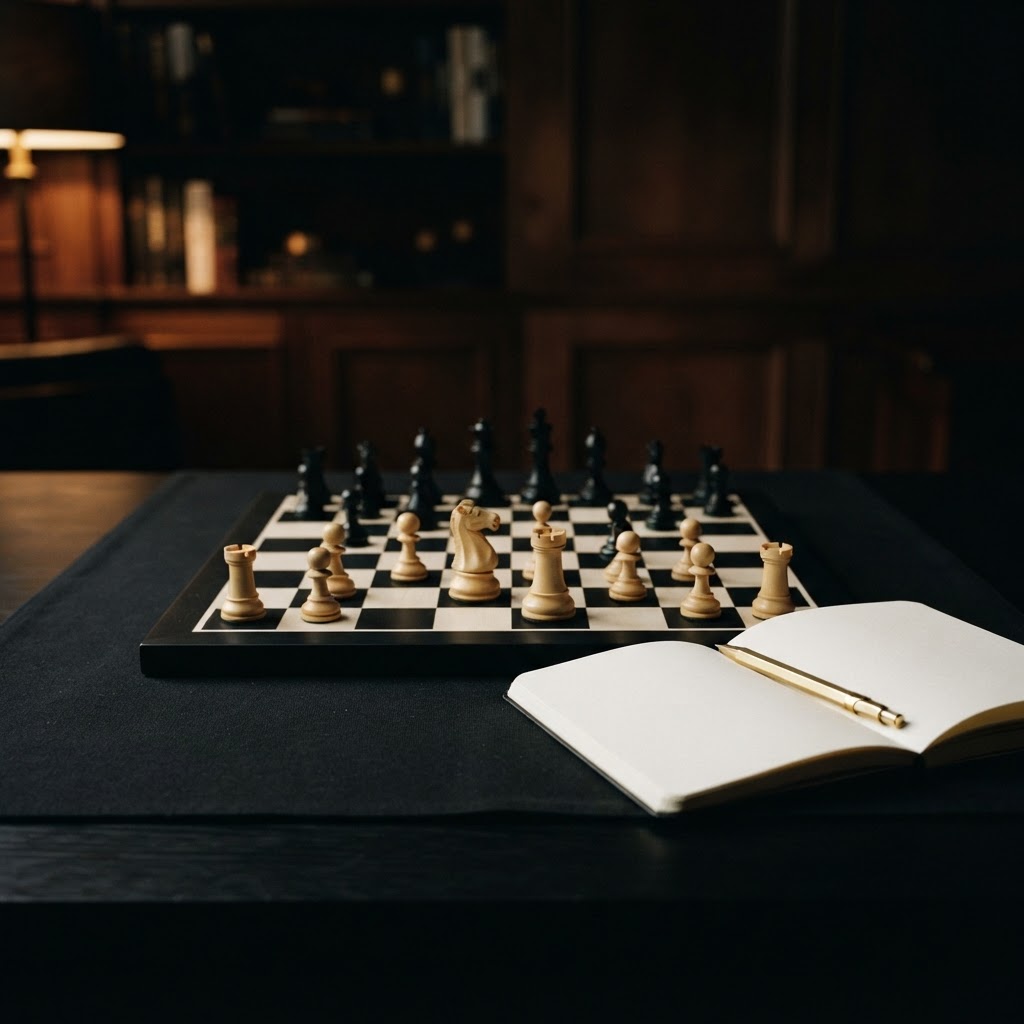
The result tells you who won. It does not tell you what to practice next. If you want to learn how to analyze your chess games, start with a smaller question: which decision would you handle differently if you reached the same position tomorrow?
This guide gives you a post-game worksheet you can use on paper or in a separate study tool. It is a suggested training routine, not a promise of better results and not a claim that ChessBet includes an analysis board or game-export feature. Finish the game before using any outside assistance. Your moves during a live contest must remain your own.
Choose one game and preserve your thinking
Pick a completed game you still remember clearly. A frustrating loss can be useful, but so can a win where your opponent let you escape. Avoid choosing only spectacular games. An ordinary position where you could not find a plan may reveal more about your training needs.
If you have a saved move record, replay it. If you do not, write down the position or decision you remember without inventing missing moves. Mark uncertain details as uncertain. An honest partial record is more useful than a reconstructed game that never happened.
Before consulting an engine, record what you were trying to do. Were you attacking the king, protecting a pawn, exchanging an active piece, or simply trying to make a safe move? Add the opponent's reply that surprised you. This preserves the difference between what you knew during the game and what seems obvious afterward.
Use a sentence like this: “I moved my rook because I wanted the open file; I did not check whether my back rank needed protection.” That gives you something to test. “I played terribly” does not.
How to analyze your chess games with a decision worksheet
Make one worksheet entry for a position you want to understand. You do not need to annotate every move. Start with a moment when your plan stopped working, you spent a lot of time without choosing confidently, or your opponent played a response you had ignored.
- Position: Record the move number and side to move, or describe the position if that is all you have.
- My intention: What did I expect my move to achieve?
- Opponent's idea: What changed after their previous move?
- Candidates: Which alternatives did I consider, and which did I overlook?
- Best reply to test: What is the most challenging response to my preferred move?
- Revised explanation: What do I now understand that I missed during play?
- Practice task: What specific exercise will address this decision?
Keep the intention and revised explanation separate. Otherwise, hindsight can rewrite your memory. You may convince yourself that you saw a threat you actually missed, or dismiss a sensible decision because the game eventually went badly.
For a first review, one fully explained entry is enough. A page of move labels without explanations gives you less to use in your next game.
Test the opponent's answer before defending your move
Return to the position before your decision and look at it from the other side. Identify checks, captures, and threats that deserve calculation. These are starting points for analysis, not instructions to play the first forcing move you find. Quiet defensive moves can matter too.
Compare your original move with an alternative. Write a short line for each, including the opponent's strongest reply you can find. Then describe the resulting position: who has more material, whose king is exposed, and which pieces can do useful work?
Suppose your original note says, “I exchanged queens to make the position easier.” Ask what the exchange actually changed. Did it lead to a pawn ending you had calculated? Did it remove your only active piece? Did you reduce the opponent's threats at an acceptable cost? The point is to replace a slogan with a reason tied to that position.
You may discover that your move was reasonable but your next decision was not. Keep those findings separate. A later mistake does not automatically invalidate an earlier plan.
Use engine feedback to answer a question
Once you have written your own analysis of the completed game, an engine can help test it. Give the engine a question rather than letting its evaluation graph choose your entire study session. For example: “Does my proposed defensive move prevent the material loss, and what reply challenges it?”
If the suggested move surprises you, follow the continuation until you can explain its purpose. Check what happens against the reply you expected. When you cannot understand the recommendation, mark it for further study rather than copying a long variation and calling the position solved.
An evaluation change is a clue to investigate. It is not an explanation of your thought process. Your notes tell you whether you failed to notice a candidate, stopped calculating too soon, or misunderstood the final position.
Keep all engine use in post-game study, away from active contests. For competition standards, consult ChessBet's Fair Play & Integrity policy. This worksheet is a learning exercise, not a method for judging another player's honesty.
Turn the finding into a small training task
Choose a task that matches the explanation in your worksheet. If you missed a knight fork, work on that tactical pattern. If you traded into a pawn ending without calculating it, set up the ending and compare the relevant lines. If you could not form a plan, study the activity of the pieces in that exact structure.
Make the task concrete enough that you can tell when you have done it. “Improve calculation” is too broad. “Return to this position, write two candidate moves, and calculate a challenging reply to each before checking” is a usable assignment.
Do not automatically diagnose every mistake as time trouble. Note whether the clock caused you to skip a check or whether uncertainty consumed the time in the first place. Those lead to different practice choices. One asks for a simpler decision routine; the other may ask for more knowledge of the position.
After several reviews, compare your worksheet entries. Repeated descriptions are a reasonable place to focus your next study session. Treat that as your own small sample, not proof that one weakness explains every result.
Bring one lesson to your next free game
Before playing again, reduce your review to one reminder you can apply without outside help: check what the opponent's last move changed, calculate before a pawn-ending exchange, or look for the defender you are about to move away. Choose the reminder that follows from your game rather than collecting a long list of rules.
ChessBet offers free play worldwide, so you can start with a free game rather than a cash contest. If real-money chess interests you later, cash-prize contests require verified age 21+ and eligibility in Arkansas, Colorado, Georgia, Iowa, Kansas, North Dakota, Texas, Virginia, Wisconsin, or Wyoming. Players must be physically located in a supported location when entering and playing. This is platform access policy, not government approval; access remains subject to applicable law and ChessBet's rules.
Read the current Official Rules and eligibility requirements before considering paid play. Training does not guarantee winnings. You can use the same worksheet whether you choose free games or eligible cash-prize contests.
Visit ChessBet to start playing free. After your completed game, save one decision, explain it honestly, and give yourself one specific thing to practice before the rematch.